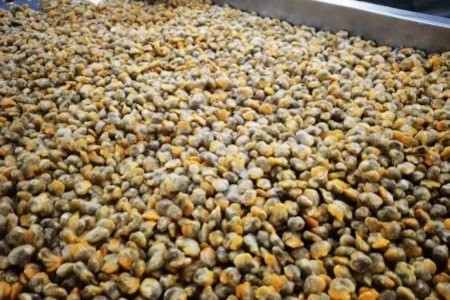
As global demand for convenient, protein-rich seafood continues to grow, frozen blood clam meat has emerged as a noteworthy commodity in international trade. While much attention focuses on live blood clams-particularly for the Thai market-the frozen variant is carving out its own niche, connecting producers in Asia with buyers across the Middle East and beyond.
One of the most concrete examples of frozen blood clam meat's export potential comes from Vietnam. In August 2024, a shipment of 540 kilograms of frozen whole blood clams (scientific name Tegillarca granosa) departed from Vietnam to Australia. The product, packaged under the brand "Master Nuts" in 900-gram bags, was shipped by SEG Global Foods Ltd, a company based in Dong Nai Province, to a buyer in New South Wales. While the shipment volume may appear modest, it signals a viable pathway for frozen blood clam products to reach premium markets with strict food safety standards.
China has also established itself as a supplier of frozen blood clam meat. Export listings from Liaoning Province-specifically Dandong City-show that Chinese producers offer Individually Quick Frozen (IQF) blood clam meat in vacuum packs, with a shelf life of 24 months when stored at -18°C. These products come in specifications of 200-300, 300-500, and 500-1000 pieces per kilogram, priced at FOB USD 2,500-3,000 per metric ton. The minimum order quantity is 10 metric tons, with supply capacity reaching 1,000 metric tons annually. This structured offering suggests that frozen blood clam meat has moved beyond ad-hoc shipments into more organized export channels.
The economic logic behind China's role in this trade is compelling. According to a 2025 report by the Food and Agriculture Organization's partner network, China accounts for forty percent of all global clam exports, making it the world's dominant producer and exporter. The country's extensive coastal farming infrastructure and established seafood processing industry provide a natural foundation for frozen blood clam meat production.
A domestic example illustrates how export-oriented initiatives can transform local economies. In Sanmen County, Zhejiang Province, a "common prosperity workshop" has helped local farmers export blood clams to the United States and the United Arab Emirates. The workshop handles customs documentation and logistics, allowing individual farmers to access international markets. Monthly exports reach 30,000 to 40,000 jin (approximately 15-20 metric tons), with export prices reaching 40 yuan per jin-double the domestic price. While this particular initiative focuses on fresh blood clams, it demonstrates the pricing premium available in overseas markets and the institutional support emerging to facilitate exports.
The broader clam trade context supports the frozen segment's growth prospects. In the first half of 2025, global clam trade increased by 12,000 tonnes compared to the same period in 2024, reaching over 155,000 tonnes. South Korea remained the largest importer, bringing in nearly 30,000 tonnes-an 18 percent increase year-on-year. Spain and Japan maintained stable import levels, while demand from EU countries like Spain and France remained strong.
For frozen blood clam meat specifically, the Middle East represents an emerging frontier. The successful exports from Sanmen to the UAE indicate that Gulf markets are receptive to blood clam products. Meanwhile, Australia's acceptance of Vietnamese frozen blood clams suggests that developed markets with significant Asian diaspora populations offer natural entry points.
The frozen blood clam meat trade is not without challenges. Bivalve products face stringent food safety scrutiny in many developed markets. A historical FAO report noted that bivalve trade between developing countries and major markets has lagged due to food safety concerns, with only a limited number of Asian countries qualified to export to the EU. However, frozen processing-particularly IQF technology-helps mitigate some of these concerns by ensuring product consistency and extending shelf life, making the frozen format more amenable to long-distance trade than live or fresh products.
Moreover, the live blood clam trade demonstrates robust demand that frozen products can complement. Thailand regularly imports live blood clams from Indonesia and Bangladesh. In February 2026 alone, Indonesia certified multiple shipments of live blood cockles to Thailand, with quarantine authorities emphasizing strict quality control to prevent rejection. Trade data shows Bangladesh suppliers shipping live blood clams to Thai buyers in volumes of 500-1,400 kilograms per transaction, with values ranging from USD 122,700 to over 343,000 per shipment. While these figures reflect live product, they confirm the existence of established buyer networks and cold-chain infrastructure that frozen products could leverage.
As global seafood consumption patterns shift toward convenience and year-round availability, frozen blood clam meat is well-positioned to capture growing demand. China's dominant production base, Vietnam's export experience, and the emergence of institutional support mechanisms like Zhejiang's common prosperity workshops all point to a maturing trade. The product's appeal spans traditional Asian markets and newer frontiers in the Middle East and Oceania. While frozen blood clam meat remains a niche category compared to mainstream seafood commodities, its trajectory suggests a steady expansion-one shipment, one market at a time.