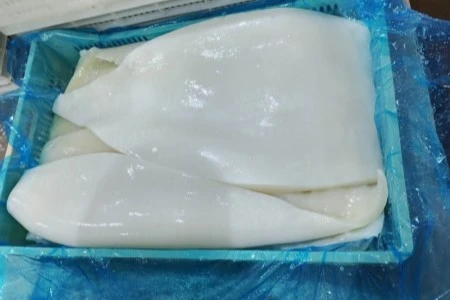
The global trade in giant squid fillets opened 2026 under a stark new equilibrium: extraordinary raw-material availability from Latin America, a Chinese market absorbing record volumes, and prices that have buckled under the weight of oversupply. For an industry long defined by China's role as the world's "squid factory," the fillet segment is now exposing both the scale of that dominance and its structural limits.
Peru delivered the decisive supply shock. From January to September 2025, Peruvian giant squid (Dosidicus gigas) landings reached a record 524,000 tonnes, a year-on-year increase of 189%, according to the Peruvian Ministry of Production. Frozen giant squid exports climbed to US$1.08 billion, more than tripling year-on-year. Shipments to China rose almost sixfold, while exports to South Korea and Spain also posted double- or triple-digit growth, with the three markets together accounting for more than three-quarters of Peru's squid exports.
That flood of raw material collided with a Chinese market that had already been building inventory. By mid-November 2025, giant squid fillet prices had fallen to an all-time low, slipping below 20,000 yuan per tonne. The drop was not simply a demand problem. Peruvian fishing had concentrated on large-sized squid, while Chinese processing companies preferred smaller and medium grades. The result was a mismatch: large fillets piled up in cold storage, while the sizes most easily absorbed by domestic processors were in short supply. One industry account described the situation bluntly: most Peruvian factories had run out of raw material for further processing and were reduced to slowly clearing remaining large-sized inventory.
The price weakness persisted into the new year. In the first week of 2026, average prices for 1–2 kg Peruvian giant squid fillets in the Chinese wholesale market fell again, extending a two-month decline. Market participants attributed the softness to high Peruvian production and successful fishing by Chinese fleets in the Southwest Atlantic, which together kept raw-material availability elevated. China's import appetite remained formidable - in July 2025 alone, the country imported 77,500 tonnes of squid and octopus products, up 106% year-on-year, with import value jumping 148% to US$279 million. But volume growth did not translate into price support.
By March 2026, however, the market began to tighten at the edges. Peruvian cumulative catches reached 140,916 tonnes by March 10, equal to 78.64% of the 179,188-tonne quota for the January–April season, but daily landings had collapsed from more than 2,000 tonnes in early March to about 532 tonnes by March 10. Argentine squid landings remained historically strong at 123,679 tonnes by early March, yet daily catch rates per vessel had fallen sharply from a peak of 36.3 tonnes to roughly 14 tonnes. In China, the wholesale price of 1–2 kg Peruvian giant squid fillets edged up by about RMB 250 per tonne (roughly US$35) in the week ending March 12, supported by measured restocking and higher fuel costs for distant-water fleets.
For the fillet trade, the deeper story lies in how the product moves through China. China accounts for over 40% of global squid exports and ships to more than 80 countries and regions, yet its export basket remains concentrated in low-added-value forms: primary frozen fillets, rings and tentacles. Shi Shengqi, president of the Zhoushan Export Aquatic Products Industry Association, noted in November 2025 that roughly 60% of Chinese squid enterprises still operate mainly as OEM manufacturers, without independent brands or a standardized quality system. The fillet, in other words, is both China's volume engine and its value trap.
The trade data reflect that tension. Large volumes of Peruvian fillets flow into Chinese ports - 27-tonne container shipments of frozen Dosidicus gigas fillets are routine - and Chinese processors re-export them in forms that capture little of the end-market premium. As Shi put it, the industry's future competitiveness will not be decided by "who catches more," but by "who catches sustainably and sells for higher prices". For now, the fillet market remains a buyer's market defined by Latin American abundance and Chinese processing capacity. Whether it becomes something more durable depends on whether the industry can move beyond the fillet as a commodity and into branded, traceable, higher-value seafood products.